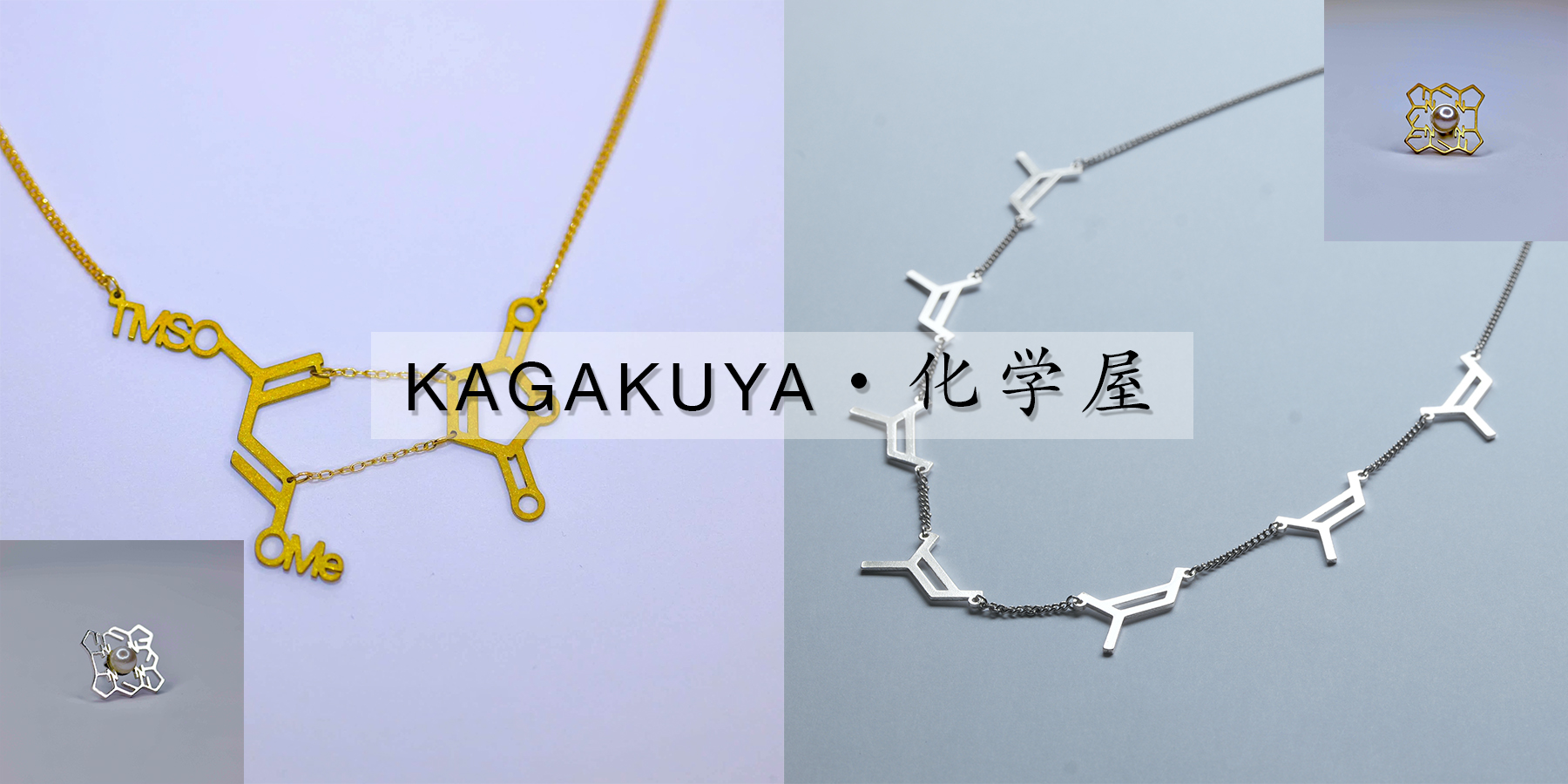
AG Gallery is pleased to announce its presentation of a new handmade jewelry collection by KAGAKUYA starting July 2025. Kagakua is a collection of jewelry made inspired by science by an artist born and raised in Japan currently based in Boston, whose specialty is science. The unique molecular structures are the core identity of this emerging brand. AG Gallery will showcase original jewelry by Kagakuya starting from July 2025, curated by the gallery director. They will be available at AG Gallery in the physical store and soon on the gallery’s official online store.
All handmade pieces by the artists at AG Gallery and About Glamour are personally selected by the Gallery Director. If you have any questions about the latest available pieces or would like to make a custom order request, please contact: natsumi@aboutglamour.net
AG Gallery also accepts international phone inquiries in Japanese and English regarding artwork purchases or consultations. Please contact us by email in advance to schedule a phone call.
_______________
ABOUT KAGAKUYA & Creator Behind 化学屋(Kagakuya):
Yuzuru Kanda was born and raised in Japan. He moved to the US in 2015, and now works at a pharmaceutical company in Boston. Alongside his scientific career, Mr. Kanda is the artist and owner of a chemistry jewelry brand, Kagakuya driven by his passion for the beauty of molecular structures. Inspired by the hidden artistry of organic molecules, Mr. Kanda wanted to transform this invisible beauty to wearable art. Mr. Kanda’s mission is to show a new appreciation for the artistic side of chesmitry that is not just about equations, but also about creativity and beauty, challenging the perception that it is a dull subject.
Currently, AGGallery is the only location in NYC where 化学屋(Kagakuya)’s handmade pieces are available to try on and purchase.
Diesl-Alder Reaction
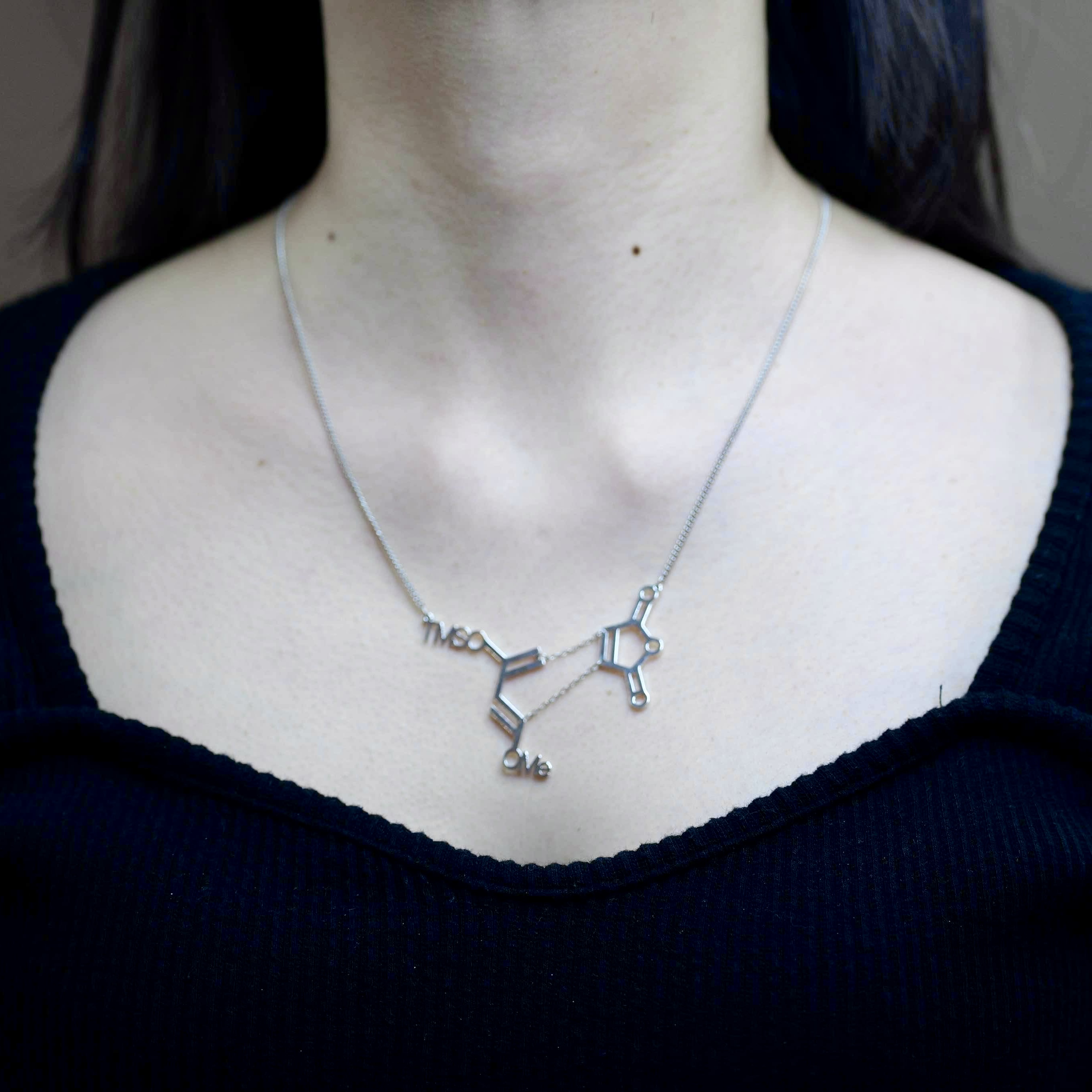
Diels-Alder reaction is a 100-year-old reaction that Diesl and Alder discovered. This powerful reaction won Novel prize in 1950 and is still widely used in synthetic labs. This jewelry represents a transition state of the four-carbon piece (left), combining with the two-carbon piece (right) to form a six-carbon ring. Although this 4+2 = 6 type reaction looks uncomplicated, the reaction proceeds well in reality only with careful substrate design. The one shown here is the almost perfect combination of reaction partners and gives a very clean reaction.
Corrin
Corrin is a core motif found in vitamin B12. The beauty of the corrin ring is its highly asymmetric structure. The left side of the molecule lacks some double bonds, and it lacks one of the bridging carbons. The middle pearl represents cobalt, which is an essential metal found in vitamin B12. The name corrin derives from the fact it was found in the core of vitamin B12.
2-Butene
But-2-enes are the simplest alkene exhibiting E/Z-isomerism; one isomer has terminal carbons on the same side, and the other does on the opposite side. Their boiling points are so close to each other that the separation of two isomers is virtually impossible, yet their physical properties are similar enough that rigorous separation is not necessary in most cases.
Polyisoprene
Polyisoprene is a string of isoprene. The chain represents the bonds between each monomer. Polyisoprene is one of the most common rubber materials. It is robust towards abrasive force and is often used for car tires and shoe soles. Unlike natural rubber latex, synthetic rubber polyisoprene is gentle on the skin and unlikely to cause allergic reactions.


You must be logged in to post a comment.